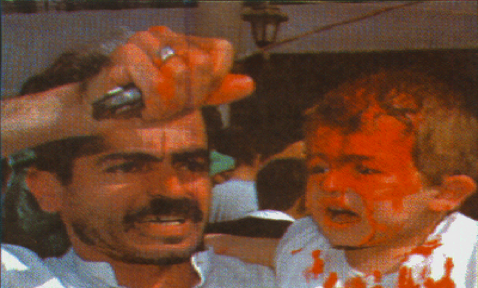
Having read an excellent account of Ashura commemorations in Beirut, I was reminded of a report I wrote as part of my university degree a while ago. I decided to publish it and see what people make of what I make of Ashura, visually, at least.
Background and introduction:
On the tenth day of Muharram, the first month of the
Islamic calendar, Muslims around the world mark the anniversary of the battle
of Karbala. The battle took place in 680AD near the city of Karbala in Iraq, between the forces of Yazid bin Muawiyah, the Umayyad caliph,
and Hussain bin Ali, grandson of Mohammed, the prophet of Islam. The latter’s
army was vastly outnumbered and suffered, in strict military terms, a heavy
defeat. However, to the 200 million or so Shia Muslims around the world (1),
it was a resounding victory for true Islam. To Shia Muslims, Hussain’s
martyrdom represents a symbol of sacrifice in the struggle for right against
wrong, and for justice and truth against wrongdoing and falsehood. (2)
Though it has been an intrinsic part of Shia Muslims’
belief and practice for centuries, the commemoration of Ashura has only
come to the anthropological fore alongside the technological advent of the
twentieth century and, particularly, the rise of photography. In this report, I
will examine a number of visual representations of Ashura and assess the
extent to which these representations have affected the collective
understanding of Ashura as an event, its legacy, practice and political
significance. Specifically, I will look at the role of the body in this
understanding and how photographs of Ashura commemorations have focused
on the body as a means of contextualising the ritual. In order to deliver a
comprehensive analysis of this rather specific subject, it is necessary that I
shed light on its historical background and contemporary significance before I
shift my focus to the camera lense and assessing its role in understanding Ashura.
The historical roots of Ashura commemorations go back
to the event itself. Upon the defeat of Hussain and subsequent captivity of his
family and relatives who were with him, his sister, Zaineb bint Ali, was
amongst those who were paraded through a number of towns and cities, till they
reached Damascus, the Umayyads’ capital city. There, she set up the very first majlis
ta’ziyah – a gathering of mourners to remember the tragedy of Ashura
through elegies and sermons in honour of Hussain bin Ali and the others who
were killed in the battle of Karbala. For Shia Muslims, setting up similar majalis
ta’ziyah became highly recommended by way of showing respect to Hussain,
his grandfather, Prophet Mohammed, and God. Such gatherings are held throughout
the year but participation significantly increases during Muharram. In
any place in the world where there are Shia Mulisms, you are likely to find
some sort of majlis ta’ziyah. For those who are able to travel, visiting
Hussain’s shrine during this month is a particularly sought pilgrimage.
Millions of mourners from all over the world flock to Iraq to pay their
respects. They would walk for days, many of them on bare feet, from
neighbouring cities until they reach Karbala and the golden-domed shrine which,
for the duration of the month, swaps the red flag atop it with a black one
(Fig: 1 and Fig: 2). Innumerable majalis ta’ziyah are held during this
month, all infusing emotional story-telling with angst over modern-day
political challenges. In the process, they reinforce a sense of community
amongst Shias and a distinct sectarian identity as distinguished from their
Sunni counterparts (Nakash: 1993). The air of sorrow, grief and remembrance
reaches a powerful climax on the tenth day, Ashura (the word ‘Ashura’
is derived from Ashra, number ten in Arabic.), when several
activities take place to mark the occasion. These include re-enactments of the
events of Ashura (Fig: 4), the recitation of a latmiyya where an
elegy is read and the mourners beat their chests in unison to a specific
rhythm. Often mourners add to the chest-beating by using chains with which they
hit their backs (Fig: 3), sometimes removing their tops so that the chains hit
the skin directly (Fig 9). Shia mourners of the Indian subcontinent go as
far as attaching curved blades to their chains (such chains are known as zanjeer) to ensure that cuts are made
and bloody wounds are inflicted (Fig: 8). In addition, there are readings of
various passages from the Quran and supplications in honour of Hussain. However,
the most controversial of these activities, one that will feature prominently
in this report, is tatbeer. This involves hitting one’s head with a sharp
object (knife, sword, blade, etc) so as to make a small cut and let blood flow
on one’s face, neck and body. In some Shia communities, tatbeer is a
private affair that isn’t performed in public. In others, it is an anticipated
highlight for which entire streets are cleared for the participants and
onlookers. Nonetheless, it has retained its controversial nature and has become
one of the most contested subjects in Islamic scholarly debate. Some have even
denounced the act and prohibited its practice (3).
Critics argue that this public display of exaggerated grief is a far cry from
the ideals and principles for which Hussain fought and died. Islamic views of tatbeer
aside, the aim of this report is to examine Ashura commemorations as
whole from an anthropological perspective.
If I were to look at Ashura commemorations through
the traditional anthropological prism which my Western education has provided
me with, I will no doubt fall short of presenting a true account of what it
represents. What distinguishes anthropology from other social sciences is that
it admits lacking absolute knowledge of its subjects. Having said that, it is
pertinent to consider non-‘academic’ dimensions and understandings when
attempting to grasp a particular subject on which little or no work has been
carried out previously. To the onlooker – anthropologist or otherwise – visual representations
of Ashura commemorations cause unease. A photograph which I have
reluctantly included show a man carrying a small boy, presumably his son, whose
face is drenched in blood having (involuntarily, I would imagine) just taken
part in tatbeer. My reluctance stems from the fact that its inclusion
would, at the very least, shock the viewer, making it doubly difficult to
explain that Ashura commemorations are a great deal more than what a
photograph is able to convey. Unless we take a more wholesome approach to
photographs and the limited extent to which they mirror humans and actions,
they will have the unintended effect of removing the medium of bodily movement
itself from serious consideration as a component of social action (Farnell:
1994). Visual evidence by itself has sparked horror amongst authorities in
Britain and has led to the arrest and conviction of a participant who, it is
alleged, forced his teenage sons to take part in “flogging.” (4) As someone who has taken part in Ashura commemorations from a very early
age, I’m in the privileged position of being able to analyse them in a way that
would avoid polemics and combine rigorous methodology with first-hand
experience of what actually takes place in these photographs. In a way, my
report is a retrospective ethnography. Extensive personal experience will,
hopefully, allow me to sidestep traditional stumbling blocks which
anthropologists have identified throughout the discipline’s evolution. An
example of the potential pitfalls of visual anthropology, a still photograph in
particular, is Evans-Pritchard’s caption under one of the images included in
his ethnography of the Nuer (Evans-Pritchard: 1987). It reads ‘Movement in the
Wedding Dance’, raising more questions about the dance and what these movements
are than it actually attempts to demonstrate.
Visual material – Tears of Imam Hussain and Ten Days:
For several years,
I had heard of plans by filmmakers to make a documentary about Ashura to
shine a light on an important Islamic festival that is often misrepresented and
misunderstood. In 2008, when Syed Mustafa Zaidi, a Pakistani Shia from
Manchester, was arrested for encouraging his two young sons to whip themselves
with chains that had curved blades – it was clear that such documentary was
much-needed. The BBC was amongst several news outlets whose reporting of the
incident was summative and, I would argue, inaccurate. However, to the layman,
it was a startling insight into a macabre world. It was yet another example of Ashura
being bandied around the internet and media outlets for the wrong reasons.
If you type in Ashura into Google or YouTube, the first several pages of
results will be images and videos of tatbeer with very little
explanation as to what these rituals mean and why people would take part in
them.
To my relief, two
filmmakers have so far gone to the trouble of producing documentaries that have
been the closest any camera has come yet to capturing Ashura
commemorations in their entirety, rather than tatbeer alone. Michel Tabet’s
Les larmes d’Hussein (The Tears of Imam Hussein) is a 55-minute
film shot entirely Nabatieh, a city in the Lebanese south, for the duration of Ashura commemorations. There was little
interaction with the camera, and participants in the commemorations were
portrayed in their very own surroundings, taking part in centuries-old
ceremonies. Interestingly, the filming coincided with the
international outrage over the infamous caricatures depicting Prophet Mohammed
in a Danish newspaper Jyllands-Posten.
In one of the scenes in the documentary, the preacher of a large mosque tells
his congregation that Imam Hussain’s struggle was to preserve true Islam, a
religion that advocated peace and ensured the dignity of followers of all
religions. The Danish caricatures, he declared, were an example of what Imam
Hussain stood against and outrage amongst Muslims was justified –necessary,
even– given the level of scrutiny Muslims have had to endure in the post-9/11
world. The congregation was energised by the preacher’s words and began chanting,
“Our dignity shall not be compromised!” in a scene that juxtaposed religious
belief with political and ideological defiance. Here, we see an example of how
an essentially religious phenomena being adapted for the political arena within
the context of Ashura. (Chelkowski:
1985)
In Nadeem Kazmi’s Ten Days, the filmmaker travels to
Punjab, Pakistan –a wholly different cultural setting in comparison to Nabatieh
– and documents the ten days over which Ashura
commemorations take place. The film is divided into ten segments, a dedicating
a segment for each day, with detailed coverage of a particularly important
period for Pakistani Shias. In contrast to Michel Tabet’s film, Ten Days pays closer attention to the
“self-flagellation”, but deftly refrains from coming across as indulgent. Although
it contains more graphic footage than Tabet’s documentary, Kazmi’s film
transcends the relatively limited realm of documentary-making and verges on
becoming a visual ethnography as it encapsulates the setting of Ashura commemorations as well painting a
vivid description of the participants. Both films are immensely relevant to
gaining a realistic insight into Ashura, though they unintentionally focus on
different themes; in Nabatieh there is an overriding air of political anger,
whereas Punjab is portrayed in scenes laced with emotive nauha (poetry recitation in a sorrowful but melodic tune), giving
the ceremonies a more serene feel.
What I found in
both films is that Ashura
commemorations, whilst culturally specific, transcend political boundaries and
unite Shia Muslims the world over. The forms of expressing grief differ from
one individual to another but the grief itself is similar. A single narrative
of sorrow and devotion underpins religious commemorations amongst a multitude
of political and ideological backgrounds, culminating in a ritual that binds
believers across borders and languages.
Ashura has retained significant political weight, both as a symbol of
resistance and as clear signifier of identity. For instance, Hasan Nasrallah,
the leader of Hezbollah, the Lebanese militant group and political party, has
made a habit of making televised appearances on the day of Ashura (Fig: 7). As well as appearing to pay his respects, such
appearances serve to reaffirm his political and ideological stance by making a
public pledge of allegiance to Hussain bin Ali, and committing to fighting
injustices, as Hussain did. Leaders of other countries with large Shia
populations make similar appearances such as Mahmoud Ahmedinejad of Iran and
Nouri al-Maliki of Iraq. Ashura is a
historical clash of political and moral stances. Fourteen centuries later, it
continues to have political and ideological significance.
Another important
aspect that Ashura commemorations
seek to highlight is the role played by women in Karbala, and their role in a
wider context. Zaineb bint Ali, Hussain’s sister, is considered one of the
greatest women in Islam for her bravery and stoicism during the fearful battle
of Karbala and her subsequent captivity. Her qualities are re-told with utmost
respect and used as a lesson for Muslim women to learn. In Ashura commemorations, women play an important role and make up a
significant proportion of attendance (Fig: 5 and 6). They take part in the
recitation of elegies and some even participate in tatbeer (Fig: 11)
Analysis:
Anthropological and
philosophical definitions of the body have, in the latter stages of the
twentieth century, undergone a radical overhaul that was partly triggered by
Foucault’s critique of traditional body classifications. In his wake, bodies
are understood as, amongst several things, ‘docile’ objects that act as arenas
on which political and social struggles are fought (Foucault: 1995). His theory
affected numerous strands of social science and helped expose the
ethnocentricity that had, until then, permeated Western spoken-language-centred
approaches to systems of meaning (Farnell: 1994).
It is highly
relevant to consider Foucault’s position as a starting point to understanding
the role, implication and overall significance of the body in the context of Ashura. Not only does the evocation of
the tragedy of Karbala centre on the brutal bodily suffering of Hussain and his
companions, the participating mourners’ bodies are used, on several occasions,
to accentuate the collective grief of Shias throughout the world. The
beating of chests, the loud crying when the story of Karbala is re-told, the
sense of collective euphoria that grips mourners – all bodily reactions –
consolidate the idea that suffering on the plains of Karbala is almost
replicated in Nabtieh or Punjab or anywhere else where the Ashura commemorations take place. The carnage that took place
nearly 1400 years ago is still fresh in Shias’ memories, and their bodies
serve as proof of this ideological and religious loyalty. To some, the pinnacle
of such affirmation is reached through a quasi-re-enactment of Ashura and the extreme physical pain
inflicted by tatbeer. Though others
may frown upon it, tatheer is
arguably the closest replication of Ashura
there is. The mental duress it requires and the physical strain it bears may
not be as great as it would seem at first, but the mourners’ body is
transported – metaphorically, I
should stress – to another time and another place, and so its psychological
effects are significant. The body remains firmly posited wherever tatbeer is taking place, but the mourner
does edge closer to empathising with the suffering of Hussain and his
companions. If Clifford Geertz were to look at Ashura commemorations and tatbeer
in particular, he would no doubt point to it and say that it is an
irrefutable example of the paradoxical way in which religion views suffering:
Hussain may have lost on the day of Ashura,
but to anyone who believes in his message and his cause, he is the victor, and
his tragedy has become a lesson in how to suffer. (Geertz: 1973). Although the
very idea is religiously perverse, I would go further by adding that it is
clear from the way in which mourners sit facing the pulpit in order to listen
to a story they know by heart bears close resemblance to the seating plans of
churches, classrooms and, as Foucault points out, prisons – all venues of
explicit exercises of power, control and indoctrination. (Foucault: 1995)
To a certain degree, the globalised world’s increasingly penetrating
lense has transmogrified a deeply spiritual practice into a mere spectacle; one
where the body is used, in several ways, to express grief, religiosity,
political identity and, ultimately, seek redemption. Despite a great deal of
religious bickering over the validity of some Ashura practices, it remains one of the most powerful symbols of
unity, strength and perseverance for Shia Muslims around the world. In my
attempt to use anthropology as tool for probing this ceremony, I hope I have
succeeded in refraining from being sacrilegious to either anthropology or Ashura, both of which I have a great amount of respect for.
1
2
3
4
5
6
7
8
9
10
11
12
13
Iranian poster. Text reads, "Muharram - the month when blood defeats the sword."
Works cited:
Nakash, Titzhak. An Attempt to Trace the Origin of the Ritual of Ashura. Die Welt des
Islam, New Series, Vol 33, Issue 2 (November, 1993), pp. 161-181.
Farnell,
Brenda. Ethno-graphics and the Moving Body. Man, New Series, Vol. 29, No. 4,
(December, 1994). pp. 929-974.
Foucault, Michel. Discipline and Punish: The Birth of the Prison.
Vintage. (April, 1995)
Evans-Pritchard, E.E. The Nuer: A Description of the Modes of Livelihood
and Political Institutions of a Nilotic People. OUP USA. 1987.
Chelkowski, Peter. Shia Muslim Processional Performances. The Drama
Review, Vol. 29, No. 3, 1985. MIT Press. pp. 18
Geertz, Clifford. Religion as a Cultural System. New York Basic Books.
(1975) p.70
Links cited: