Thursday, 27 March 2014

Looking Less, Living More

This time last week I was an absent-minded twenty-five year old guy trying to work out what’s happening in his dizzying and erratic life. Now, I’m asking the same questions having made no real advances in my dilettantish quest. The only difference between then and now is that I can no longer see as I did a few days ago.

Over the weekend, I suffered a relapse. It loosened a single, minute muscle that helps move eyes from side to side. I can look to the left with my left eye, but the right eye is unable to follow suit. Similarly, my right eye inches towards the right whilst its twin is stopped in its tracks and fails to move in the same direction. When I look directly in front of me, at my nose for instance, my eyes do a little jiggle before they sit next to eachother like the old buds that they are. Whilst this happens, my eyes cross, I feel a sharp pang in my brain followed by an undetectable, inaudible clicking sound in my head signaling my eyes’ alignment once again. This last movement clears up my vision as if it were Google Streetview after the page loads: foggy at first then it’s clear once you stop moving and looking around your crush’s neighbourhood.

I found that it helps to cover one eye and have the other do all the work. At first, I did this using my palm, then I covered it with a floral eye mask that reminded a friendly shopkeeper of Pudsey Bear, the eye-patched chugger-cum-mascot the BBC wheels for Children In Need – quite a cheering compliment given my uncertainty towards my sudden and uncontestable change of look.

After several trips to an eye hospital’s A&E and orthoptics clinic, I was told I have suffered a relapse that triggered what is known as Bilateral Internuclear Ophthalmoplegia. They also gave me a pair of glasses with a sticky material covering one lense so that it looks as though I’ve been in a steam room. This, I was told, would allow my eye to get some air whilst it is rested from doing any real vision work. Alternatively, I could wear an eye-patch that completely shields the eye from any light or vision. When I wear the eye-patch, I would still blink, but I don’t see much save for some grey and black swirls akin to those you see when you close your eyes and rub them, an illusory meteor shower glittering the weary inside of my eyelid.

All movement around the house and on the street is slow and stuttering. My judgment of distances has shot to hell and I’m forever bumping into open doors, doorframes and a whole host of stationary objects that evade my narrowing line of vision.

Internuclear Ophtalmoplegia usually occurs amongst those who’ve suffered a stroke. Cases amongst younger patients such as myself are often caused by Multiple Sclerosis. I must admit that in the seven years that I’ve lived with MS, I haven’t relapsed in a way that has hammered home the impact this disease could have on my life – until now. I may have been unstable on my feet, forgetful and achy, but never visibly struck by illness.

The prospect of spending the rest of my life like this, or, even worse, with no vision at all – terrifies me. It’s not a fear of losing my sight per se, I’m scared I won’t be able to see the darling of my damaged eye flourish, grow and become an independent, loving and unrestrained spirit. And though the idea of (very slowly) running around the park with her pretending to be a pirate would delight her and other children in the vicinity, I confess to being wary of the new boundaries restricting my mobility. The extent of my involvement in my fledgling family’s life is the cloud that shrouds my spirits. That said, and naïve and short-sighted (poignant pun?) though I may be, I don’t care what besets my ailing body so long as my mind is intact and able to compose intelligible sentences –whether by writing or dictation à la Jean-Domonique Bauby. That, for me, should be enough.

I’m aware of the considerable anxiety this relapse has brought those around me, and that is an added worry for me. I don’t wish for people to panic, nor do I want them to pity me. I’m the same person. I haven’t changed one bit. I’m just a little slower when I move and I will occasionally don a piece of unconventional eyewear.

This time last week I had wanted to write but didn’t find the time to. Today I have written a few modest passages with one eye, and, in the process, have unburdened myself of quite a spiky thorn I was handed over the weekend.

Things must be on the up.

Tuesday, 11 March 2014

Writhing On Paper


As American teeth clattered under the inauspicious halo of an "arctic vortex”, and as Southern England was soaked till the water came up again, I was having a meteorological meltdown of my own. It was in my head and it’s still raging.

Pathetic fallacy aside, I’ve been feeling irredeemably low lately. My body has become a piece of cotton being tossed about by impersonal and unrelenting winds, an empty wooden vessel carried by the water underneath.

I’d never felt this helpless in all my adult life.

Perhaps my slowly subsiding health had something to do with it. Whilst my head played reluctant host to ever-entwining intrusive thoughts that were mostly negative (the rest I consign to the Unspeakably Bizarre category), my body gradually weakened till it became quite a struggle to move without a grimace or a groan.

It’s as if my kneecap were replaced by a jello-laden sheet of plastic: any movement hurts. Some movements more than others, but each and every single time I move my knees, it hurts. I guess I’ve become so used to the numb pain that it doesn’t hurt or burn the same way a freshly open wound hurts and burns.

What I need is a release.. and what better way to channel one’s pent-up frustration with Nature’s impenetrable might than to write. I realise that it won’t make the pain any less real, but it’s a chance to articulate it, understand it, and, hopefully, give those around me a way of understanding what I’m going through. I won’t be writhing on my own. Rather, I’ll be writhing in writing, which sounds –and feels– considerably better than squaring up my illness in a solitary, invisible fashion.

That said, I’m not entirely sure whether it’s helpful to relive the challenging physical and mental conditions that I began this piece by subtly alluding to. I don’t think a limb-by-limb account of what I go through is essential. The idea, I hope, has been conveyed.

What I worry about sometimes isn’t whether I’ll be able to walk or talk in a few years’ time. I don’t look forward to that, nor do I wish it becomes a reality. Multiple Sclerosis is an unpredictable disease and I should never be naive enough to hazard a guess as to how it will affect me over the next few years. The thing that scares me is wasting what little time I have left doing something I don’t particularly want, something that doesn’t move me from the very core.. something that doesn’t stir my soul.

A life of intellectual, emotional and personal mediocrity is what many people seem unwittingly content to bequeath their children. I don’t want that for myself, nor for my darling daughter whose insatiable appetite for life instils in me an incredible, unshakeable will to keep going. It is this, I believe, that has sustained me through my darkest hour yet.

I don’t think conventional medicine has yet come up with a real antidote to pain that’s amplified by one’s exaggerated yet somehow palpable fears. If such a miracle drug has been found, my doctors aren’t being very honest with me. So for the time being, what I ought to do is purse my lips lest I wallow in self-pity, and commit to expressing my innermost physical and emotional fears on paper.

Once I lay my fingers on a keyboard or wrap them snugly round a pen, I will feel a slight relief. I always do.

Saturday, 15 February 2014

Home Away From Home

The last time I felt so serene and peaceful I was around thirteen years old. The narrow streets that zigzagged through the centre of Old Damascus were where I felt completely and totally calm. There was intermittent noise, but it always emanated from humans. The most advanced piece of machinery in sight was a coffee machine that cost 10 Syrian Liras to use, and the only time I ever used it, I was with Mohamed Homeidan, my friend and pubescent confidant. We’d decided we were going to do what cool grown-ups did and buy non-traditional instant coffee from the shops opposite al-Asiyya, the famous Christian school close to our own school, right in the middle of the Old Damascus, arguably the oldest inhabited city on this peculiar planet. As Homeidan placed his plastic cup where the thirty-something year-old shopkeeper had instructed him, horror covered his face as the steaming hot chocolate poured in front of his widened eyes next to the cup, not in it, as we had both hoped. The shopkeeper shrugged and said he wasn’t responsible for my friend’s casual approach to delicate technology. His precious cash trickled down the small machine’s mesh-covered drain, and with it, our sense of how old we were instantly shrivelled to its natural, naive scope: thirteen, clumsy and hard to embarrass.

Incidents like this were the thread that bound me to Damascus, especially the sections of the city whose walls seemed to contain within them the dreams and tragedies of an infinite number of people who’ve all left behind indelible marks on the city’s spiritual landscape.. invisible cloaks unknowingly worn by Damascus’s proceeding inhabitants. Sadly, once I became aware of my deep affinity to “Dimashq”, my family and I had packed our suitcases and returned from a seven-year jaunt, to our old home in London, England.

For years afterwards, the sense of tranquility brought on by Damascus’s visibly-ancient buildings remained elusive, and I often spoke silkily of it – Its enveloping serenity was never replicated until I set foot in Zaytouna Street in Tunis.

In late January, I had to make two brief trips to Tunisia to cover the third anniversary of the revolt that toppled President Bin Ali and sparked ongoing confrontations between angry, disillusioned Arabs and the state apparatus. The sentiment that roused such rage was similar across the region. The people want to overthrow the president/government/king/system. What was different in each case was, in my humble and uninformed opinion, the level of outside influence and the extent to which people -particularly the political elite- were willing to compromise on their long-silenced demands. Maybe the coming months will allow me to travel to other revolutionary hotspots, but for the time being, Tunis was the only place I could think of. It was to be the first time I set foot on African soil - sorry, Mr Ali Farka Toure, my infantile dreams of unceremoniously landing in Bamako will have to be postponed till time/money/energy/fate dictates otherwise.

The idea of a "business trip" made my heart sink with dread. Much as I enjoyed work, I couldn’t stomach the idea of holding our team meetings in hotel lobbies. Luckily, and typically, my fears were exaggerated as I had plenty of time to spend on my own, aimlessly walking through Tunis’s backstreets and crowded traditional markets. Some of my colleagues didn’t seem to thrive in the environment as much as I did, and weren’t so comfortable with the idea of eating in restaurants whose shaky tables roofed stray cats that were occasionally given slithers of kind punters’ food. I, on the other hand, relished the opportunity of being there. I wasn’t worried about catching a tropical bug (“It is Africa, afterall!”), nor was I concerned about having a meal without being given a conventional receipt to claim back from my company’s finance department.

The instant we walked out of the arrivals’ gate, I turned to my colleague and said with a joyous but muffled tone:

“I feel like I’m going home.”

Knowing I had never visited Tunisia nor had any relatives there, he smiled back with a mix of sympathy and confusion.

As we reached the hotel, and over the remainder of our short visit, not once did I feel like a stranger, tourist or a visitor. I was amongst people I was comfortable speaking to. They all exuded an incredible feeling of familiarity and friendliness that you rarely found in London.

Most of the trip was spent organising the two television programmes we were set record to examine the impact of the Tunisian revolution on people’s lives, how they feel about the past three years, and whether they’re hopeful of a less rocky road ahead now that a new constitution has been drafted, albeit after months of political gridlock and the assassination of two of the country’s leading figures of the Left, Chokri Belaid and Mohamed Brahmi – real and bloody turning points in the post-January 14 Tunisia. A new constitution was being hailed as a huge stride in the country’s stuttering march towards the democratic, citizen-respecting state so much had been sacrificed for. Not to forget the newly-chosen Prime Minster who just so happened to share my name.

All the Tunisians I spoke to were upbeat about their country’s prospects. Though their views on Mohamed al-Boazizi differed, they were in near-unanimous agreement that the future is theirs to shape, if only foreign meddling ceased. Financial backing is important, many said, but it must not be at the expense of national stability and the secular identity Tunis prides itself in.
There was overwhelming positivity that people maintained despite the testing times they lived in. What, record unemployment, a gaping chasm between rich and poor, several incidents of industrial action (on our first visit, the city was dotted with heaps of rubbish, and some of it was burnt in a big square next to our hotel sending fumes of thick and throat-tickling smoke all around the city centre.) and the spectre of civil and political disintegration à la Damascus looming large – drafting a new constitution was an important sign that things were on the up, unlike fellow Arab Springers such as Libya, Egypt and, most prominently, Syria. Such optimism was infectious and I’m certain I came back to London feeling slightly less gloomy about everyone and everything than when I left a week or two ago.
A crucial asset that Tunis, and other countries in the region, must utilise if they are to lift themselves out of the political, social and economic quagmire they're languishing in – is the youth population. On account of what I saw, Tunisians have already made the important steps. All that remains is to keep up the fervour and zeal to rebuild their country; the young people I was so privileged to meet were nothing short of inspirational. Whether driving cool hatchbacks whilst listening to the likes of Jimi Hendrix and Flume, or sipping warm tea on a cafe’s rooftop that overlooks large parts of the old city and its cement-roofed souk - everyone I met was brimming with energy, excitement and confidence for what the future held for them.

After a few days amongst the generous, warm and inviting people of Tunis, it was with great sadness that I watched Carthage Airport get smaller and smaller as the Tunis Air flight made its bumpy way to London.

Nonetheless, I feel blessed to have finally found a place I can call, with some confidence, my home away from home.


P
 Photos courtesy of John Prendergast.

Friday, 3 January 2014

New year, old demons

Every day that I live, every person that I meet, every reaction to what I say or do - all confirm to me what I already suspect: I'll never be understood by those around me.

I feel extremely out of place amongst most of my contemporaries, and even those who I'm closest to can't comprehend the extent of my difference to them all. Of course, this isn't to say I'm better looking or smarter or more ambitious than they are. I'm just in a totally different place to where everyone else is. Whatever that means, I haven't got a clue.

I'm burdened by the weight of my own thoughts. I can't even follow a coherent sequence of thoughts in order to jot them down.

I don't think I'll ever find a place or a person who'll unlock a vault of happiness so far invisible to me. Rather, I'm fully aware of how only I can find my own path to being happy. I must immerse myself in things that make me happy, surround myself by people who understand me, read books that speak to me.

The new year has not ushered in a whole raft of self-improving resolutions aimed at yanking me away from the ever-encroaching tentacles of life. Instead, I am hoping that the new year earmarks the beginning of my phase of literary productivity. I don't really care about speaking to people who'll nod in sympathetic agreement. I want to transfer my thoughts from brain to book and hope that, one day, someone will read it and feel as if I'd articulated what the reader is feeling.

Till then, I shall keep writing.

Saturday, 7 December 2013

Madiba 'Mourned'

The world was caught completely off guard by news of Nelson Mandela's passing. The fact that he was living out his ninth decade may have softened the blow for some, myself included, but my initial reaction scarcely extended beyond the acceptance of what's inevitable, and the hope that humanity would, for once, learn a thing or two from this great man's life.

Within a matter of minutes, though, any hopes I had momentarily and naively harboured were quickly dashed as I, along with almost everyone in the Western world, was treated to a spectacle of amateurish play-acting. The fervent fawning was perhaps a last-gasp attempt to make us forget that Mandela had been, until 2008, labelled a "terrorist" by some of the statesmen now queuing up to heap posthumous praise. What further ground my guts was the media's transforming of a man of solid, radical principles (countless examples of which were compiled by my namesake's latest Huff Puff) into a saintly celebrity of global, era-defining proportions. The blanket coverage was choke-full of gushing tributes that deftly blanked out the slightly crucial detail of what he really spent his entire life opposing. In doing so, major media outlets had produced a series of obituaries with a narrative that would not have pleased Madiba unless he'd undergone a lobotomy on the sly. Admittedly, he was only fighting minor remnants of centuries of colonial arrogance, as Musa Okwonga eloquently put it, so choosing not include this in an obituary is understandable given the restrictions of time/space that journalists must adhere to these days.

Our grim world is full of hypocrites who will try, and fail, to morph the late South African president into a poster boy. He may have become so in the eyes of the historically amnesic; for the rest of us, however, he is lesson upon lesson in humility, perseverance and unequivocal rejection of oppression no matter who this oppression is meted out against.

Friday, 6 December 2013

Seven Years

In April 2006, I started this blog with a wild, faint hope of being spotted by a web-savvy journalist who would have stumbled here as he/she trawled through the dozens of Iraqi blogs that were sprouting at the time. The idea was that said journalist would write a feature on me, and then his/her editor would have been so impressed by my talent and ambition that I would be contacted soon afterwards by a number of reputable publications vying for my byline. None of that happened, of course. In fact, this far-fetched dream, whilst sounding like a Hollywood PG script, was not as big a deal to me as the above paragraph may suggest.

I began writing here as a way of communicating the mix the angst and awe that most eighteen year-olds feel. The months that followed were pivotal in my life, and this serene place proved an invaluable retreat that allowed me to make sense of it all: it became my sanctuary, my safe place. In it, I was able to express myself freely and without fear of being interrupted, as I so often am, or judged. The vastness of the world wide web offered a buffer from life's single and most potent threat; people. Weirdly, those whose judgement and criticism I had braced myself for were, more or less, the ones who encouraged me to keep writing. And so I did.

That said, I must confess a great deal of guilt towards this blog. The past couple of years have seen its level of new material plummet till it almost became defunct. In my meek defence, I've been very preoccupied by the endless chores and challenges -for want of a better word- my strange life keeps throwing at me. Chief amongst these is my degree whose commencement was announced with measured but heartfelt jubilation just over seven years ago. It is with mixed feelings that I am finally able to inform my few but oh so dear readers that the degree is -at long, long last- finished, and I am days away from donning the bizarre mortar board to signal the completion of an immeasurably fruitful stage of my life. The turning points that have taken place during these seven years are too many to list in one post. I suppose sifting through the archive may give you a few clues as to what I'm alluding to; but, whilst it was all happening at mystifying speed, I had never stopped wanting to come back here to jot down a few hundred words about what I was saw and how I felt.

Here's to the next seven years of living, loving and writing all about it here.

Incidentally, seven is my favourite number. It sounds pensive, unassuming and keeps itself to itself. I'm the seventh child in my family and one of my favourite Norah Jones songs is called Seven Years, hence the title.

Friday, 8 November 2013

Ashura - Visual Narratives of Blood and Belief

Having read an excellent account of Ashura commemorations in Beirut, I was reminded of a report I wrote as part of my university degree a while ago. I decided to publish it and see what people make of what I make of Ashura, visually, at least. 

Background and introduction:
On the tenth day of Muharram, the first month of the Islamic calendar, Muslims around the world mark the anniversary of the battle of Karbala. The battle took place in 680AD near the city of Karbala in Iraq, between the forces of Yazid bin Muawiyah, the Umayyad caliph, and Hussain bin Ali, grandson of Mohammed, the prophet of Islam. The latter’s army was vastly outnumbered and suffered, in strict military terms, a heavy defeat. However, to the 200 million or so Shia Muslims around the world (1), it was a resounding victory for true Islam. To Shia Muslims, Hussain’s martyrdom represents a symbol of sacrifice in the struggle for right against wrong, and for justice and truth against wrongdoing and falsehood. (2)
Though it has been an intrinsic part of Shia Muslims’ belief and practice for centuries, the commemoration of Ashura has only come to the anthropological fore alongside the technological advent of the twentieth century and, particularly, the rise of photography. In this report, I will examine a number of visual representations of Ashura and assess the extent to which these representations have affected the collective understanding of Ashura as an event, its legacy, practice and political significance. Specifically, I will look at the role of the body in this understanding and how photographs of Ashura commemorations have focused on the body as a means of contextualising the ritual. In order to deliver a comprehensive analysis of this rather specific subject, it is necessary that I shed light on its historical background and contemporary significance before I shift my focus to the camera lense and assessing its role in understanding Ashura.

The historical roots of Ashura commemorations go back to the event itself. Upon the defeat of Hussain and subsequent captivity of his family and relatives who were with him, his sister, Zaineb bint Ali, was amongst those who were paraded through a number of towns and cities, till they reached Damascus, the Umayyads’ capital city. There, she set up the very first majlis ta’ziyah – a gathering of mourners to remember the tragedy of Ashura through elegies and sermons in honour of Hussain bin Ali and the others who were killed in the battle of Karbala. For Shia Muslims, setting up similar majalis ta’ziyah became highly recommended by way of showing respect to Hussain, his grandfather, Prophet Mohammed, and God. Such gatherings are held throughout the year but participation significantly increases during Muharram. In any place in the world where there are Shia Mulisms, you are likely to find some sort of majlis ta’ziyah. For those who are able to travel, visiting Hussain’s shrine during this month is a particularly sought pilgrimage. Millions of mourners from all over the world flock to Iraq to pay their respects. They would walk for days, many of them on bare feet, from neighbouring cities until they reach Karbala and the golden-domed shrine which, for the duration of the month, swaps the red flag atop it with a black one (Fig: 1 and Fig: 2). Innumerable majalis ta’ziyah are held during this month, all infusing emotional story-telling with angst over modern-day political challenges. In the process, they reinforce a sense of community amongst Shias and a distinct sectarian identity as distinguished from their Sunni counterparts (Nakash: 1993). The air of sorrow, grief and remembrance reaches a powerful climax on the tenth day, Ashura (the word ‘Ashura’ is derived from Ashra, number ten in Arabic.), when several activities take place to mark the occasion. These include re-enactments of the events of Ashura (Fig: 4), the recitation of a latmiyya where an elegy is read and the mourners beat their chests in unison to a specific rhythm. Often mourners add to the chest-beating by using chains with which they hit their backs (Fig: 3), sometimes removing their tops so that the chains hit the skin directly (Fig 9). Shia mourners of the Indian subcontinent go as far as attaching curved blades to their chains (such chains are known as zanjeer) to ensure that cuts are made and bloody wounds are inflicted (Fig: 8). In addition, there are readings of various passages from the Quran and supplications in honour of Hussain. However, the most controversial of these activities, one that will feature prominently in this report, is tatbeer. This involves hitting one’s head with a sharp object (knife, sword, blade, etc) so as to make a small cut and let blood flow on one’s face, neck and body. In some Shia communities, tatbeer is a private affair that isn’t performed in public. In others, it is an anticipated highlight for which entire streets are cleared for the participants and onlookers. Nonetheless, it has retained its controversial nature and has become one of the most contested subjects in Islamic scholarly debate. Some have even denounced the act and prohibited its practice (3). Critics argue that this public display of exaggerated grief is a far cry from the ideals and principles for which Hussain fought and died. Islamic views of tatbeer aside, the aim of this report is to examine Ashura commemorations as whole from an anthropological perspective.
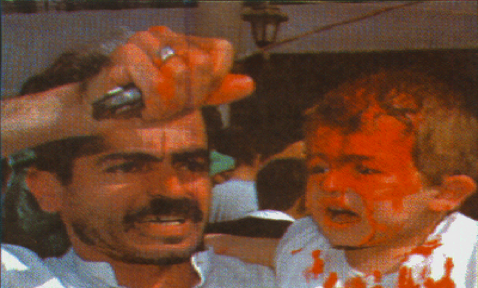
If I were to look at Ashura commemorations through the traditional anthropological prism which my Western education has provided me with, I will no doubt fall short of presenting a true account of what it represents. What distinguishes anthropology from other social sciences is that it admits lacking absolute knowledge of its subjects. Having said that, it is pertinent to consider non-‘academic’ dimensions and understandings when attempting to grasp a particular subject on which little or no work has been carried out previously. To the onlooker – anthropologist or otherwise – visual representations of Ashura commemorations cause unease. A photograph which I have reluctantly included show a man carrying a small boy, presumably his son, whose face is drenched in blood having (involuntarily, I would imagine) just taken part in tatbeer. My reluctance stems from the fact that its inclusion would, at the very least, shock the viewer, making it doubly difficult to explain that Ashura commemorations are a great deal more than what a photograph is able to convey. Unless we take a more wholesome approach to photographs and the limited extent to which they mirror humans and actions, they will have the unintended effect of removing the medium of bodily movement itself from serious consideration as a component of social action (Farnell: 1994). Visual evidence by itself has sparked horror amongst authorities in Britain and has led to the arrest and conviction of a participant who, it is alleged, forced his teenage sons to take part in “flogging.” (4) As someone who has taken part in Ashura commemorations from a very early age, I’m in the privileged position of being able to analyse them in a way that would avoid polemics and combine rigorous methodology with first-hand experience of what actually takes place in these photographs. In a way, my report is a retrospective ethnography. Extensive personal experience will, hopefully, allow me to sidestep traditional stumbling blocks which anthropologists have identified throughout the discipline’s evolution. An example of the potential pitfalls of visual anthropology, a still photograph in particular, is Evans-Pritchard’s caption under one of the images included in his ethnography of the Nuer (Evans-Pritchard: 1987). It reads ‘Movement in the Wedding Dance’, raising more questions about the dance and what these movements are than it actually attempts to demonstrate.
Visual material – Tears of Imam Hussain and Ten Days:
For several years, I had heard of plans by filmmakers to make a documentary about Ashura to shine a light on an important Islamic festival that is often misrepresented and misunderstood. In 2008, when Syed Mustafa Zaidi, a Pakistani Shia from Manchester, was arrested for encouraging his two young sons to whip themselves with chains that had curved blades – it was clear that such documentary was much-needed. The BBC was amongst several news outlets whose reporting of the incident was summative and, I would argue, inaccurate. However, to the layman, it was a startling insight into a macabre world. It was yet another example of Ashura being bandied around the internet and media outlets for the wrong reasons. If you type in Ashura into Google or YouTube, the first several pages of results will be images and videos of tatbeer with very little explanation as to what these rituals mean and why people would take part in them.
To my relief, two filmmakers have so far gone to the trouble of producing documentaries that have been the closest any camera has come yet to capturing Ashura commemorations in their entirety, rather than tatbeer alone. Michel Tabet’s Les larmes d’Hussein (The Tears of Imam Hussein) is a 55-minute film shot entirely Nabatieh, a city in the Lebanese south, for the duration of Ashura commemorations. There was little interaction with the camera, and participants in the commemorations were portrayed in their very own surroundings, taking part in centuries-old ceremonies. Interestingly, the filming coincided with the international outrage over the infamous caricatures depicting Prophet Mohammed in a Danish newspaper Jyllands-Posten. In one of the scenes in the documentary, the preacher of a large mosque tells his congregation that Imam Hussain’s struggle was to preserve true Islam, a religion that advocated peace and ensured the dignity of followers of all religions. The Danish caricatures, he declared, were an example of what Imam Hussain stood against and outrage amongst Muslims was justified –necessary, even– given the level of scrutiny Muslims have had to endure in the post-9/11 world. The congregation was energised by the preacher’s words and began chanting, “Our dignity shall not be compromised!” in a scene that juxtaposed religious belief with political and ideological defiance. Here, we see an example of how an essentially religious phenomena being adapted for the political arena within the context of Ashura. (Chelkowski: 1985)
In Nadeem Kazmi’s Ten Days, the filmmaker travels to Punjab, Pakistan –a wholly different cultural setting in comparison to Nabatieh – and documents the ten days over which Ashura commemorations take place. The film is divided into ten segments, a dedicating a segment for each day, with detailed coverage of a particularly important period for Pakistani Shias. In contrast to Michel Tabet’s film, Ten Days pays closer attention to the “self-flagellation”, but deftly refrains from coming across as indulgent. Although it contains more graphic footage than Tabet’s documentary, Kazmi’s film transcends the relatively limited realm of documentary-making and verges on becoming a visual ethnography as it encapsulates the setting of Ashura commemorations as well painting a vivid description of the participants. Both films are immensely relevant to gaining a realistic insight into Ashura, though they unintentionally focus on different themes; in Nabatieh there is an overriding air of political anger, whereas Punjab is portrayed in scenes laced with emotive nauha (poetry recitation in a sorrowful but melodic tune), giving the ceremonies a more serene feel.
What I found in both films is that Ashura commemorations, whilst culturally specific, transcend political boundaries and unite Shia Muslims the world over. The forms of expressing grief differ from one individual to another but the grief itself is similar. A single narrative of sorrow and devotion underpins religious commemorations amongst a multitude of political and ideological backgrounds, culminating in a ritual that binds believers across borders and languages.
Ashura has retained significant political weight, both as a symbol of resistance and as clear signifier of identity. For instance, Hasan Nasrallah, the leader of Hezbollah, the Lebanese militant group and political party, has made a habit of making televised appearances on the day of Ashura (Fig: 7). As well as appearing to pay his respects, such appearances serve to reaffirm his political and ideological stance by making a public pledge of allegiance to Hussain bin Ali, and committing to fighting injustices, as Hussain did. Leaders of other countries with large Shia populations make similar appearances such as Mahmoud Ahmedinejad of Iran and Nouri al-Maliki of Iraq. Ashura is a historical clash of political and moral stances. Fourteen centuries later, it continues to have political and ideological significance.
Another important aspect that Ashura commemorations seek to highlight is the role played by women in Karbala, and their role in a wider context. Zaineb bint Ali, Hussain’s sister, is considered one of the greatest women in Islam for her bravery and stoicism during the fearful battle of Karbala and her subsequent captivity. Her qualities are re-told with utmost respect and used as a lesson for Muslim women to learn. In Ashura commemorations, women play an important role and make up a significant proportion of attendance (Fig: 5 and 6). They take part in the recitation of elegies and some even participate in tatbeer (Fig: 11)
Analysis:
Anthropological and philosophical definitions of the body have, in the latter stages of the twentieth century, undergone a radical overhaul that was partly triggered by Foucault’s critique of traditional body classifications. In his wake, bodies are understood as, amongst several things, ‘docile’ objects that act as arenas on which political and social struggles are fought (Foucault: 1995). His theory affected numerous strands of social science and helped expose the ethnocentricity that had, until then, permeated Western spoken-language-centred approaches to systems of meaning (Farnell: 1994).
It is highly relevant to consider Foucault’s position as a starting point to understanding the role, implication and overall significance of the body in the context of Ashura. Not only does the evocation of the tragedy of Karbala centre on the brutal bodily suffering of Hussain and his companions, the participating mourners’ bodies are used, on several occasions, to accentuate the collective grief of Shias throughout the world. The beating of chests, the loud crying when the story of Karbala is re-told, the sense of collective euphoria that grips mourners – all bodily reactions – consolidate the idea that suffering on the plains of Karbala is almost replicated in Nabtieh or Punjab or anywhere else where the Ashura commemorations take place. The carnage that took place nearly 1400 years ago is still fresh in Shias’ memories, and their bodies serve as proof of this ideological and religious loyalty. To some, the pinnacle of such affirmation is reached through a quasi-re-enactment of Ashura and the extreme physical pain inflicted by tatbeer. Though others may frown upon it, tatheer is arguably the closest replication of Ashura there is. The mental duress it requires and the physical strain it bears may not be as great as it would seem at first, but the mourners’ body is transported  – metaphorically, I should stress – to another time and another place, and so its psychological effects are significant. The body remains firmly posited wherever tatbeer is taking place, but the mourner does edge closer to empathising with the suffering of Hussain and his companions. If Clifford Geertz were to look at Ashura commemorations and tatbeer in particular, he would no doubt point to it and say that it is an irrefutable example of the paradoxical way in which religion views suffering: Hussain may have lost on the day of Ashura, but to anyone who believes in his message and his cause, he is the victor, and his tragedy has become a lesson in how to suffer. (Geertz: 1973). Although the very idea is religiously perverse, I would go further by adding that it is clear from the way in which mourners sit facing the pulpit in order to listen to a story they know by heart bears close resemblance to the seating plans of churches, classrooms and, as Foucault points out, prisons – all venues of explicit exercises of power, control and indoctrination. (Foucault: 1995)
To a certain degree, the globalised world’s increasingly penetrating lense has transmogrified a deeply spiritual practice into a mere spectacle; one where the body is used, in several ways, to express grief, religiosity, political identity and, ultimately, seek redemption. Despite a great deal of religious bickering over the validity of some Ashura practices, it remains one of the most powerful symbols of unity, strength and perseverance for Shia Muslims around the world. In my attempt to use anthropology as tool for probing this ceremony, I hope I have succeeded in refraining from being sacrilegious to either anthropology or Ashura, both of which I have a great amount of respect for. 
1
 2
 3
 4
 5
 6
 7
 8
 9
 10
 11
 12
 13
    Iranian poster. Text reads, "Muharram - the month when blood defeats the sword."

Works cited:
Nakash, Titzhak. An Attempt to Trace the Origin of the Ritual of Ashura. Die Welt des Islam, New Series, Vol 33, Issue 2 (November, 1993), pp. 161-181.
Farnell, Brenda. Ethno-graphics and the Moving Body. Man, New Series, Vol. 29, No. 4, (December, 1994).  pp. 929-974.
Foucault, Michel. Discipline and Punish: The Birth of the Prison. Vintage. (April, 1995)
Evans-Pritchard, E.E. The Nuer: A Description of the Modes of Livelihood and Political Institutions of a Nilotic People. OUP USA. 1987.
Chelkowski, Peter. Shia Muslim Processional Performances. The Drama Review, Vol. 29, No. 3, 1985. MIT Press. pp. 18
Geertz, Clifford. Religion as a Cultural System. New York Basic Books. (1975) p.70
Links cited:

Mohammed Hussain Fadhlullah: http://english.bayynat.org.lb/ashura/


[1] Mapping the Global Muslim Population: A Report on the Size and Distribution of the World’s Muslim Popluation.
[2] Al-Shia Fi Al Mizan, Mohammed Jawad Mughniyya, Beirut, n.d. pp. 396-97.
[3] http://english.bayynat.org.lb/ashura/
[4] http://news.bbc.co.uk/1/hi/england/manchester/7634275.stm